> For the complete documentation index, see [llms.txt](https://docs.getinfinity.app/user-guide/llms.txt). Markdown versions of documentation pages are available by appending `.md` to page URLs; this page is available as [Markdown](https://docs.getinfinity.app/user-guide/comprehensive-user-guide/9.-subscriptions/event-based-notifications-alerts.md).
# Event Based Notifications (Alerts)
Infinity’s **Event-Based Notifications aka Alerts** provide a powerful way to stay informed about critical data changes in real-time. Unlike scheduled emails, which deliver reports at fixed intervals, alerts **trigger instantly** when defined conditions are met—allowing you to take action when it matters most.
### **Creating an Alert**
Alerts can only be created for **Charts** (not available at the Storyboard level). There are **two ways** to set up an alert:
#### **1. Using the Chart’s Menu**
1. Click on the **Chart Name** to navigate to the **Chart Details Page**.
2. Click on the **three-dot menu (⋮)** in the top-right corner.
3. Select **Subscribe** → **Event Notification**.
4. Define your **trigger condition**:
* Set up **simple conditions** like:\
**“Notify me when sales drop by 10% week-over-week”**
* Build **complex conditions** using functions and computes.
5. Click **Subscribe** to confirm.
#### **2. Using the Chatbot**
1. Open the chatbot.
2. Type a command such as:\
**"Alert me if website traffic drops by 5% this week"**
3. The chatbot will display the **confirmation**.
### **Building Complex Alert Conditions**
Infinity allows users to create **sophisticated alert logic** by combining multiple conditions. Using logical operators like **UNION** and **INTERSECT**, users can define alerts that trigger based on complex logic. For instance :
* **Condition A UNION Condition B** → The alert triggers if **either** condition A **or** condition B is met.
* **Condition A INTERSECT Condition B** → The alert triggers **only if both** conditions A **and** B are met at the same time.
For more advanced conditions, [**user-defined computes**](/user-guide/comprehensive-user-guide/12.-advanced-topics/custom-computes-for-event-based-subscriptions.md) allow for highly customized data monitoring. Computes are analytical programs that dynamically evaluate trigger conditions, making Infinity’s alert system one of the most powerful in the market.
***
### **How Alerts Differ from Scheduled Emails**
While both **Alerts** and **Scheduled Emails** keep users informed, they serve **different purposes**:
🔹 **Scheduled Emails** are time-based and **send periodic reports** on a fixed schedule (daily, weekly, monthly), regardless of whether data has changed.\
🔹 **Alerts** are **event-driven**, meaning they only trigger **when a specific condition is met** in the data.
**Example Use Case:**
* A **scheduled email** might send a **weekly sales report** every Monday morning.
* An **alert** might notify you **immediately** if sales **drop by more than 10%** from the previous week.
Alerts provide **real-time monitoring** and **proactive notifications**, making them ideal for **tracking sudden changes, anomalies, or critical thresholds** in data.
***
### **Receiving Notifications**
Once an alert is triggered, you will receive a **notification through multiple channels**:
✅ **Slack** (if integrated)\
✅ **Email** (sent directly to your inbox)\
✅ **In-App Notifications** (via the **bell icon** 🔔 in the top-right corner)
With this **set-and-forget** approach, Infinity ensures you’re instantly informed about crucial changes—without manually checking reports.
***
### **Managing Your Alerts**
Users can manage their alerts through the **Subscriptions Page**:
1. Click the **Subscriptions Icon** in the **left-hand menu**.
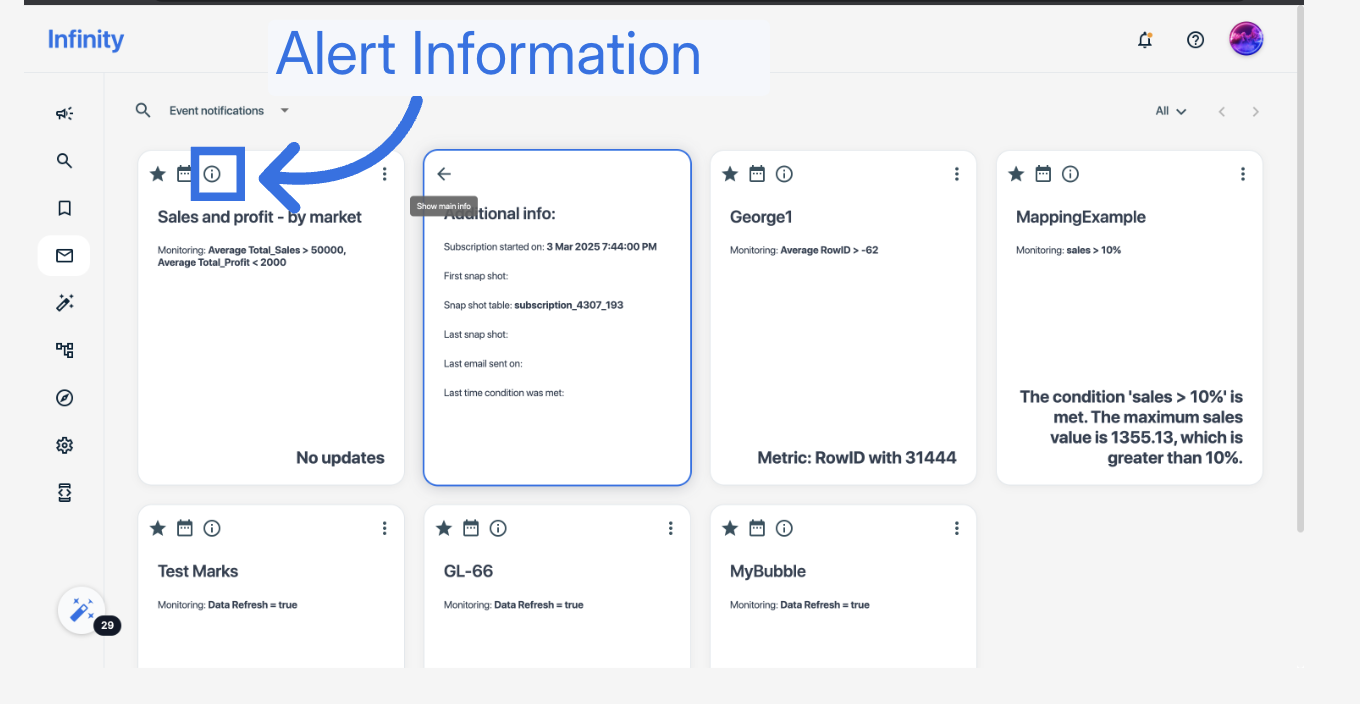
2. Select **Event Notifications** to see all active alerts.
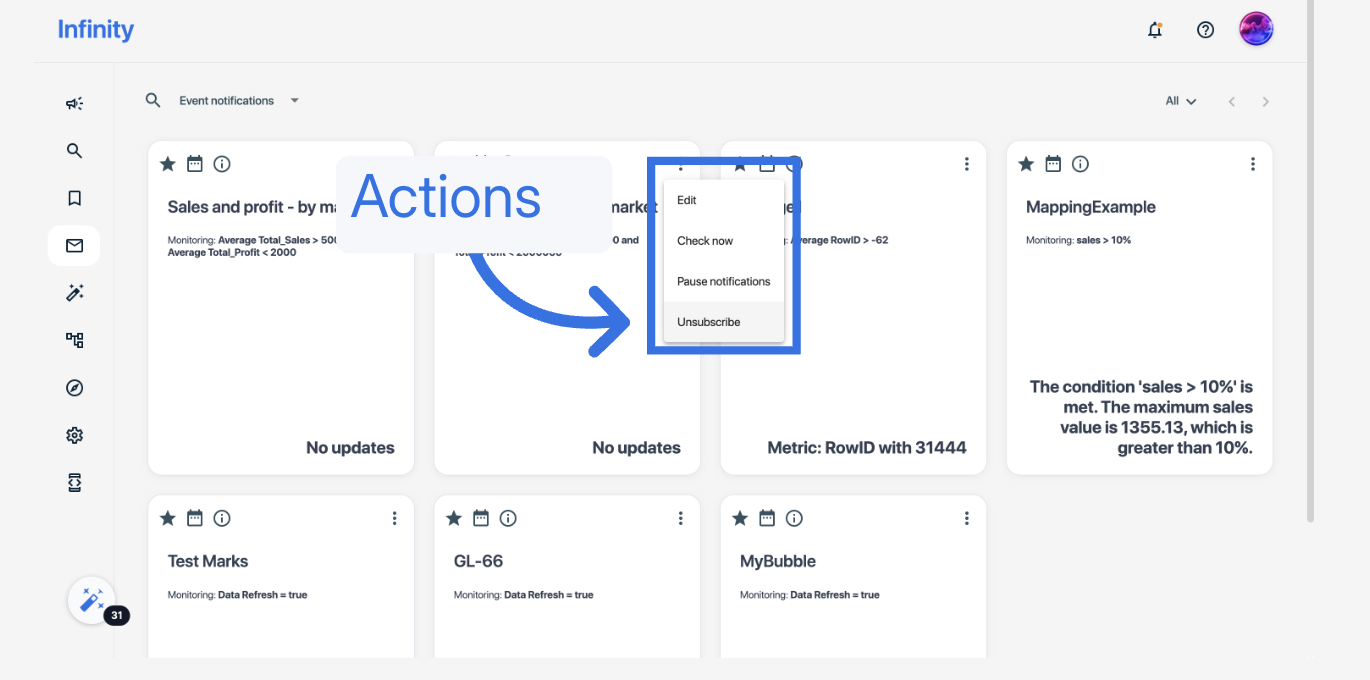
3. Take action using the available controls:
* **Click the "Info" icon** to view alert details.
* **Use the three-dot menu (⋮)** to:
* **Pause** an alert temporarily.
* **Modify conditions** as needed.
* **Unsubscribe** to stop receiving notifications.
* **Check the status** of the alert (active, paused, triggered, etc.).
#### **Admin Management**
Admins and users with [**Manage Subscriptions**](/user-guide/comprehensive-user-guide/9.-subscriptions/managing-alerts-and-scheduled-emails.md) permissions can **view, edit, pause, or delete alerts for all users** in the organization. This enables centralized alert management, ensuring teams stay informed while preventing redundant or unnecessary notifications.
* Admins can **assign alerts** to users or teams.
* They can **modify conditions** or update recipients as needed.
* They can **review all active alerts** for compliance and efficiency.
***
### **Premium Feature**
🚀 **Alerts are a premium feature** available only on select plans. Check your Infinity subscription to ensure access to real-time, event-driven notifications.
***
By using **Alerts**, Infinity ensures users are always aware of critical data changes—**proactively and in real-time**. 🚀