> For the complete documentation index, see [llms.txt](https://docs.getinfinity.app/user-guide/llms.txt). Markdown versions of documentation pages are available by appending `.md` to page URLs; this page is available as [Markdown](https://docs.getinfinity.app/user-guide/comprehensive-user-guide/2.-charts/featured-chart-examples/bubble-chart.md).
# Bubble Chart
In this article, we will explain how to create and customize a bubble chart. So let's get started!
## 📈 Bubble Chart
A **Bubble Chart** is a powerful way to visualize multi-dimensional data in a single view. It’s especially useful when you want to:
* **Compare multiple metrics** across categories
* Identify **patterns or outliers**
* Show **correlations** between variables
* Represent a fourth variable using **bubble size** or **color**
***
### 🧠 When to Use a Bubble Chart
Use a bubble chart when:
* You have **at least three** numerical measures to plot.
* You want to highlight how **categories** compare across multiple dimensions.
* You need to visualize **volume or magnitude** (with bubble size) and **intensity** (with bubble color).
**Common use cases:**
* Market performance (e.g. sales vs. profit vs. discount)
* Product comparisons (e.g. revenue vs. cost vs. margin)
* Regional analysis (e.g. growth vs. customer base vs. churn)
***
### 🧩 Bubble Chart Attributes
Each bubble represents one data point (e.g. a market or product) and can encode up to **five attributes**:
| Attribute | Description | Required |
| --------------- | -------------------------------------------------------------- | ----------- |
| **Bubble Name** | Label/ID for the bubble (e.g. `Market`) | ✅ |
| **X-Position** | Value on the X-axis (e.g. `Sales`) | ✅ |
| **Y-Position** | Value on the Y-axis (e.g. `Profit`) | ✅ |
| **Color** | Value used for gradient coloring or grouping (e.g. `Quantity`) | ⭕ Optional |
| **Size** | Determines the diameter of the bubble (e.g. `Discount`) | ⭕️ Optional |
| **Order By** | Optional sorting field (e.g. `Market`) | ⭕️ Optional |
> ℹ️ *Color* can be either:
>
> * a **string** to group bubbles by category
> * a **number** to apply a color gradient (e.g., intensity)
***
### 🛠️ Creating a Bubble Chart
#### Step 1: Enter Your Prompt in the builder
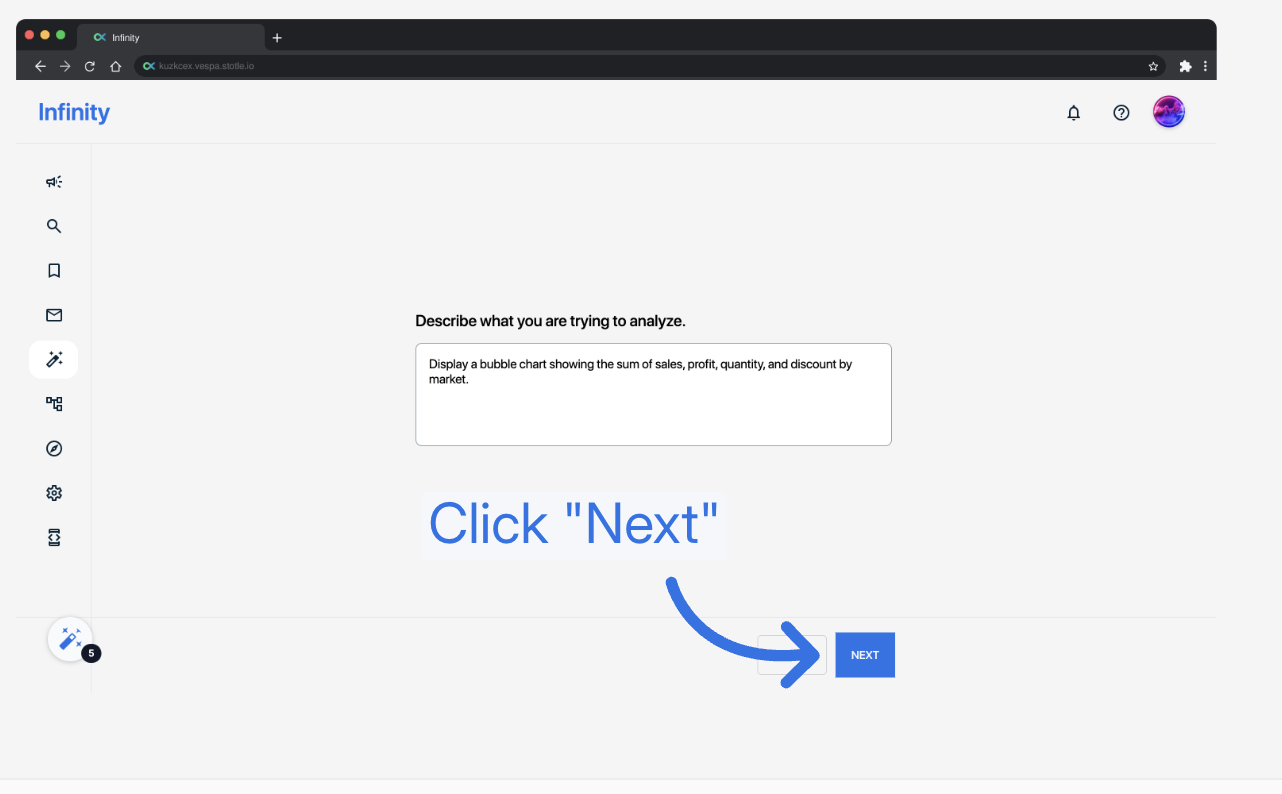
In the **Intent panel**, describe what you want to visualize.\
Example prompt:
> `Display a bubble chart showing the sum of sales, profit, quantity, and discount by market.`
Click **Next** to proceed.
***
#### Step 2: Map Attributes
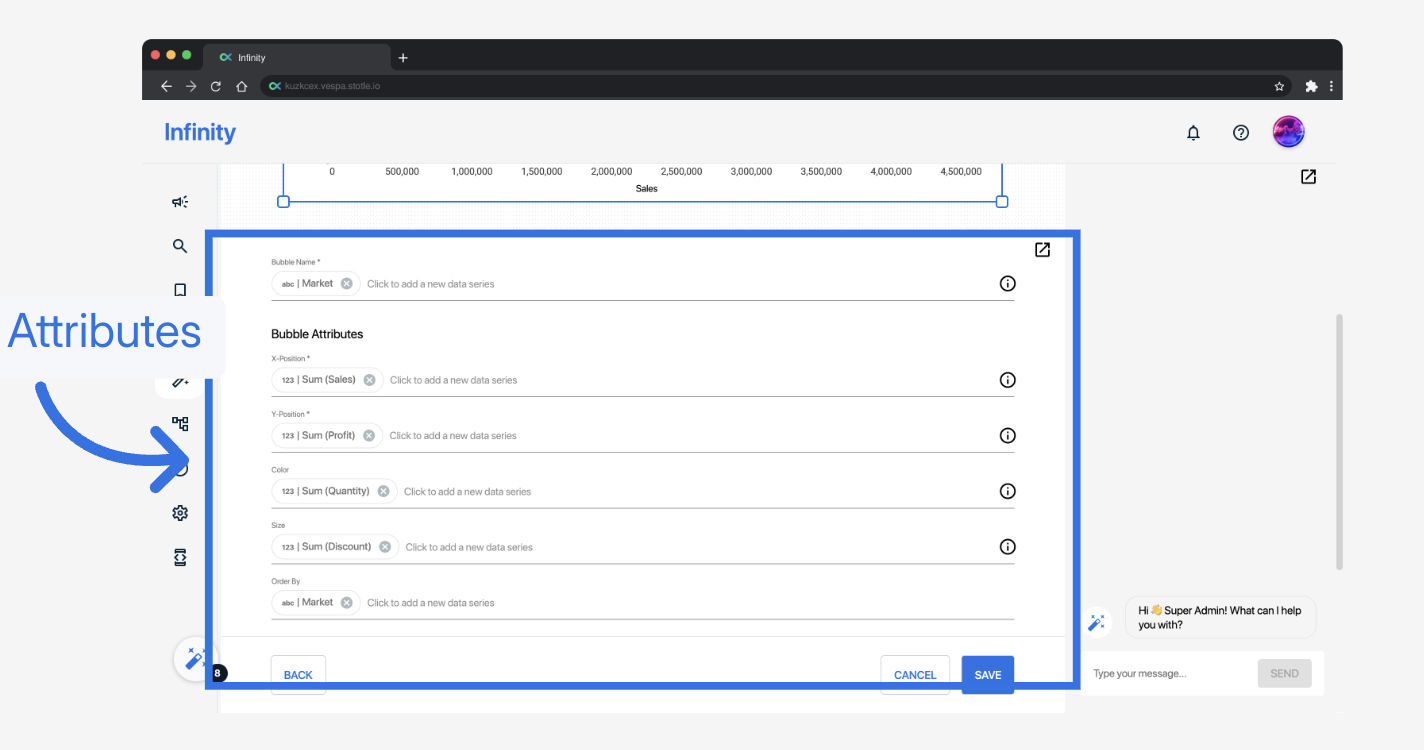
The AI would map your fields to the bubble chart properties:
* **Bubble Name** → `Market`
* **X-Position** → `Sum(Sales)`
* **Y-Position** → `Sum(Profit)`
* **Color** → `Sum(Quantity)` *(optional)*
* **Size** → `Sum(Discount)` *(optional)*
* **Order By** → `Market` *(optional)*
Click **Save** to generate the chart.
***
### 🎨 Customizing the Chart
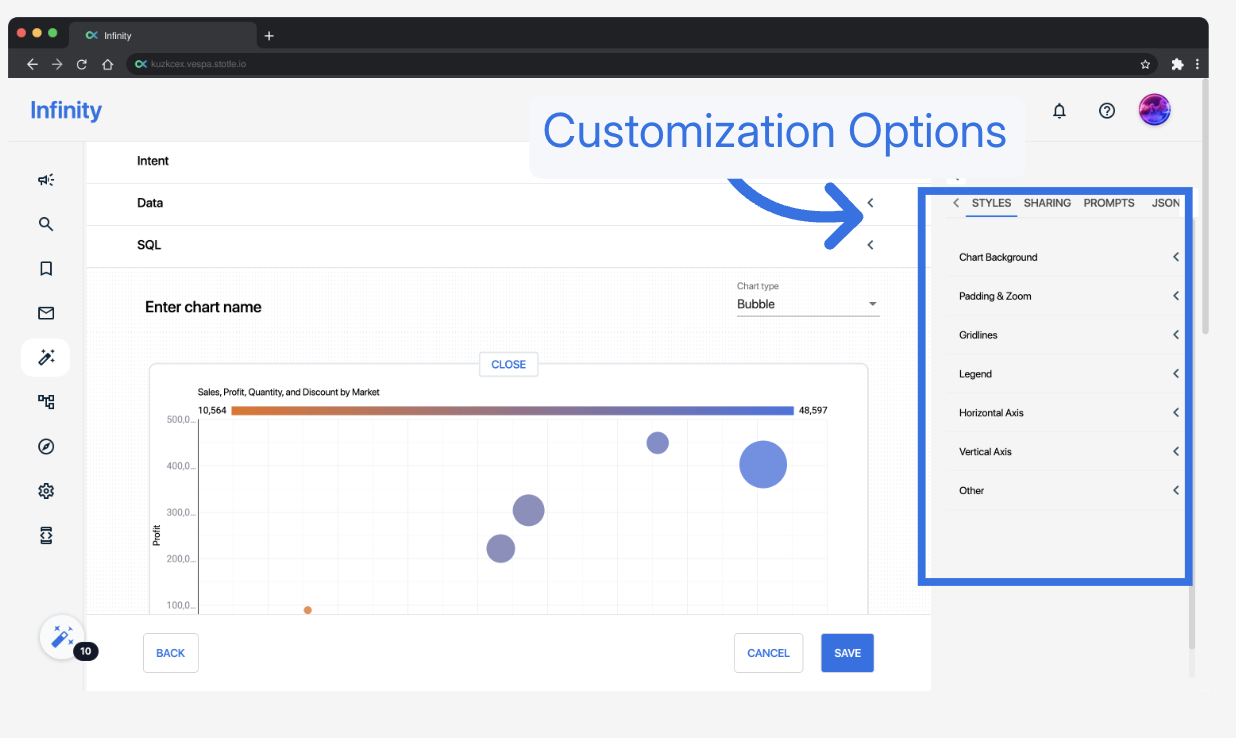
To access customization options:
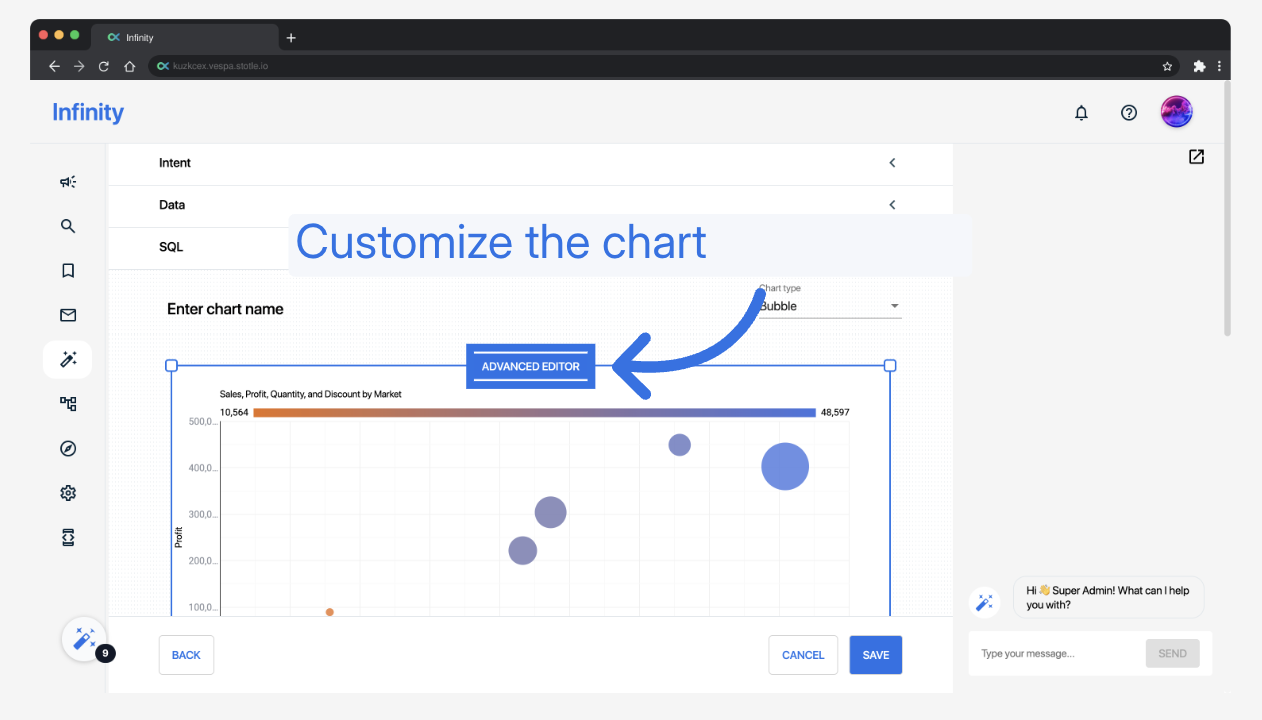
1. Click **Advanced Editor** at the top of the chart.
2. Open the **Styles** tab on the right panel.
From there, you can adjust:
* **Chart Title**
* **Gridlines** (horizontal/vertical)
* **Legend** (position and display)
* **Bubble Opacity**
* **Color Range** (gradient stops and min/max)
* **Bubble Font** (text style, color, size)
* **Chart Padding & Zoom**
* **Background Styling**
> ⚙️ Advanced users can also switch to the **JSON** tab to directly edit chart config options.
***